If your child has been referred to a speech therapist, or you have concerns about how they talk or understand, you may be wondering what a speech therapist actually does. Many parents picture pronunciation drills, but the role is much wider.
A speech therapist, also called a speech-language pathologist (SLP), assesses and treats difficulties with speech, language, voice, fluency, social communication and swallowing. This guide explains what they do, the children they help, and what to look for when you choose one.
What Is a Speech Therapist?
A speech therapist is a trained healthcare professional who specialises in communication and swallowing. In India, speech therapists complete a bachelor’s degree in audiology and speech-language pathology (BASLP), and many go on to a master’s degree (MASLP). To practise, they must be registered with the Rehabilitation Council of India (RCI).
Speech therapists work in hospitals, schools, clinics and child development centres. Those who work with children are often called paediatric speech therapists, because they understand how communication develops from infancy through the school years.
What Does a Speech Therapist Do?
Assesses Your Child's Communication
Every plan starts with a detailed speech and language assessment. The therapist talks with you about your child’s history, observes them during play, and uses age-appropriate tests to check understanding, expression, speech sounds, fluency and social communication.
Finds the Cause of the Difficulty
The therapist looks at why your child is struggling. Speech delay can be linked to hearing problems, autism, weak oral muscles or a language disorder, so they may suggest a hearing test for children or another evaluation before therapy begins.
Sets Clear, Measurable Goals
Based on the assessment, the therapist sets goals such as using two-word phrases, saying a specific sound correctly, or following two-step instructions. Clear goals make it easy for you to see progress.
Runs Play-Based Therapy Sessions
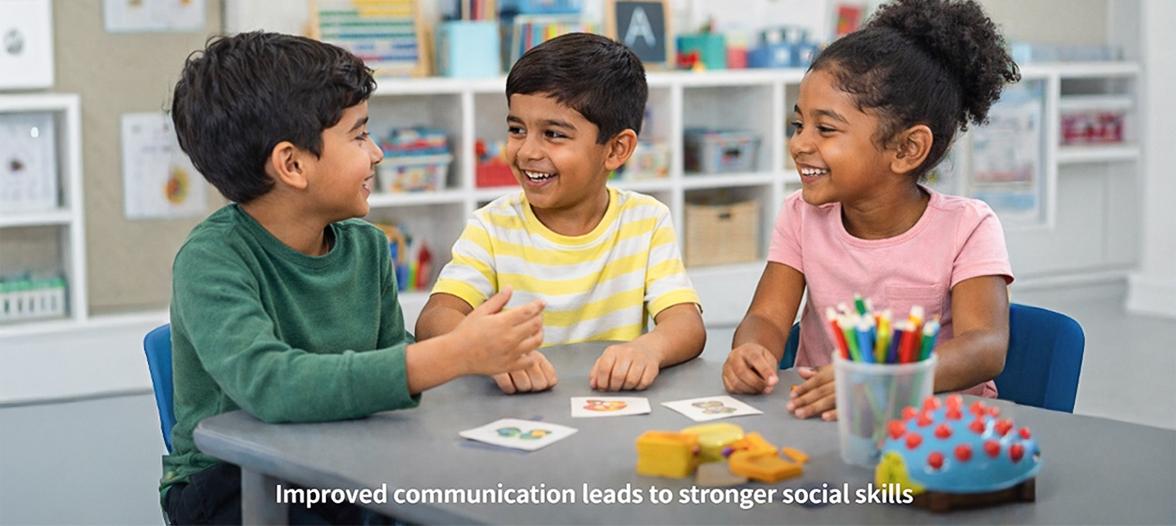
For young children, therapy looks a lot like play. Therapists use toys, picture cards, songs, games and everyday routines to teach new words, sounds and conversation skills, because children learn best when they are relaxed and engaged.
Coaches Parents for Practice at Home
Children spend far more time at home than in therapy. A good speech therapist shows parents simple ways to practise during meals, bath time and play, so that progress continues between sessions.
Works With Other Specialists
Many children benefit from more than one kind of support. Speech therapists often work alongside occupational therapists, ABA therapists, special educators and audiologists so that everyone works towards the same goals.
Conditions a Speech Therapist Treats
- Speech and language delay: late talking, a small vocabulary or difficulty forming sentences.
- Articulation and phonological disorders: unclear speech, or sounds that are missed or replaced.
- Stammering (stuttering): repeated sounds, stretched words or blocks while speaking.
- Autism spectrum disorder: difficulties with social communication, back-and-forth conversation or using words to communicate.
- Childhood apraxia of speech: difficulty planning the mouth movements needed for speech.
- Hearing loss: building listening and speech skills in children who use hearing aids or cochlear implants.
- Voice disorders: a hoarse, breathy or strained voice.
- Feeding and swallowing difficulties: problems with chewing, swallowing or accepting different food textures.
Methods Speech Therapists Use
- Play-based therapy to build language through toys, games and routines.
- Articulation therapy to teach the correct position of the tongue, lips and jaw for each sound.
- Oral-motor exercises to strengthen the muscles used for speech and feeding.
- Fluency techniques, such as slow and easy speech, for children who stammer.
- Augmentative and alternative communication (AAC), such as picture boards or speech apps, for children who are not yet speaking.
- Social communication training to practise turn-taking, greetings and conversation.
Parents sometimes worry that AAC will stop their child from learning to talk. It does not. Giving children a way to communicate often reduces frustration and supports speech development.
When Should You See a Speech Therapist?
Consider an assessment if your child:
- Is not babbling by 12 months, or not using single words by 16 to 18 months
- Is not combining two words by 2 years
- Is hard for family members to understand by 3 years
- Stammers often, or shows tension or frustration while speaking
- Has difficulty following simple instructions or answering questions
- Avoids talking with other children or struggles to make friends
Read more about the signs your child may need speech therapy. If you are unsure, an early assessment is always better than waiting.
How to Choose the Right Speech Therapist
- Qualifications: Check that the therapist holds a BASLP or MASLP degree and RCI registration.
- Experience with children: Ask about their experience with your child’s specific difficulty.
- Assessment first: A good therapist assesses before recommending a plan or number of sessions.
- Parent involvement: You should be welcome to observe sessions and receive activities to do at home.
- Progress reviews: Ask how often goals are reviewed and how progress is shared with you.
Conclusion
A speech therapist does much more than correct sounds. They assess your child’s communication, find the cause of any difficulty, set clear goals, run engaging sessions and guide you to support your child at home.
At RISE Care, our qualified team provides speech therapy services in Chennai for children of all ages, from first words to school-age communication. To see how therapy helps over time, read about the benefits of speech therapy for children.
Frequently Asked Questions (FAQs)
What is the difference between a speech therapist and a speech-language pathologist?
There is no difference. Both terms describe the same professional. In India, “speech therapist” is the more common term, while “speech-language pathologist” (SLP) is used more in clinical and academic settings.
What qualifications should a speech therapist have in India?
A speech therapist should hold a BASLP (Bachelor in Audiology and Speech-Language Pathology) or a higher degree such as an MASLP, and be registered with the Rehabilitation Council of India (RCI).
Do I need a doctor's referral to see a speech therapist?
No. At RISE Care you can book a speech and language assessment directly. Your paediatrician may also refer you if they notice a delay.
At what age can a child see a speech therapist?
Children can see a speech therapist at any age. Feeding and early communication support can start in infancy, and most speech and language delays respond best when therapy starts early, ideally before age 3.
How long is a speech therapy session?
Sessions for children usually last 30 to 60 minutes, one to three times a week, depending on the child’s needs. The therapist recommends a schedule after the assessment.
Can a speech therapist help a child with autism?
Yes. Speech therapists help autistic children communicate in the way that works best for them, including spoken words, gestures, pictures or AAC, and they also work on social communication skills.