
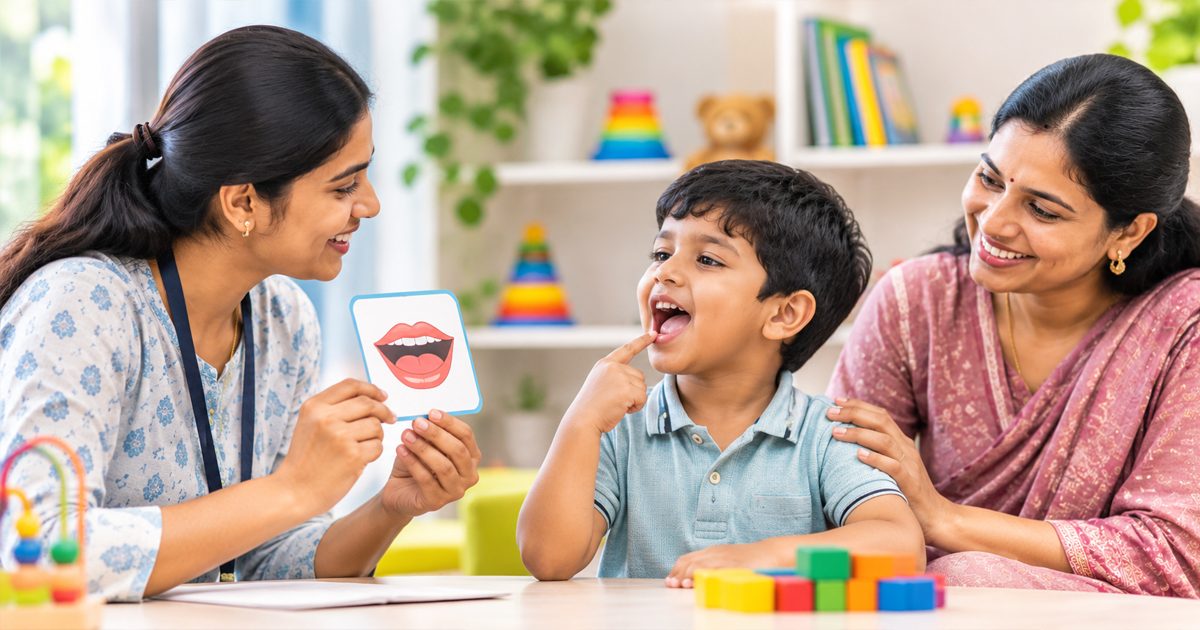
A child may have plenty to say but still struggle to make themselves understood. They may point instead of using words, avoid answering questions, speak in sentences that are difficult to follow, or become upset when others do not understand them.
Sometimes, these difficulties are mistaken for shyness, stubbornness, inattention, or simply being a “late talker.” Persistent challenges with speech, language, understanding, or social communication may need a closer look. Knowing the signs your child may need speech therapy can help you decide when to seek support.
Speech therapy provides structured support to help children develop the communication skills they need at home, in school, and while interacting with others. The benefits of speech therapy for children extend beyond clearer speech, helping children understand language, express themselves, participate in conversations, and communicate more confidently.
What Is Speech Therapy?
Speech therapy is a specialised service that assesses and supports difficulties related to speech, language, communication, voice, fluency, and, when relevant, feeding and swallowing. A speech-language pathologist evaluates the child’s individual strengths and difficulties before deciding which areas require support.
For children, speech therapy may address concerns such as:
- Difficulty pronouncing certain sounds
- Limited vocabulary
- Difficulty forming sentences
- Trouble understanding questions or instructions
- Stuttering or other fluency difficulties
- Challenges with social communication
- Difficulty communicating wants, needs, thoughts, or feelings
- Certain feeding and swallowing difficulties
Therapy does not look the same for every child. A child working on pronunciation may need very different activities from one who is still developing vocabulary or learning how to participate in conversations.
At RISE Development Centre, speech and language therapy is part of the developmental services offered to children, with therapy planned around the child’s individual communication needs.
Benefits of Speech Therapy for Children
The advantages of speech therapy are not limited to helping a child “speak better.” Communication affects how children learn, play, interact, express themselves, and participate in everyday life.
1. Improving Speech Clarity and Articulation
A child who drops, swaps, or distorts sounds may be difficult for others to understand. Rather than simply asking the child to “say it properly,” a speech therapist identifies the specific sounds or speech patterns affecting clarity and works on them systematically.
Therapy may involve learning where to place the tongue and lips, controlling airflow, and practising sounds in words, sentences, and everyday conversations. As the child becomes more consistent, they may need to repeat themselves less often.
Clearer speech can make everyday communication easier, whether the child is answering a question in class, talking to family, playing with friends, or expressing what they need.
The goal is not perfect speech overnight. It is helping the child communicate more clearly, one step at a time.
2. Expanding Vocabulary and Sentence Structure
Knowing a few words is different from being able to use language effectively. A child may understand more than they can express, struggle to find the right words, or know individual words but have difficulty combining them into meaningful sentences.
Speech therapy can support both expressive language, which involves using words and sentences, and receptive language, which involves understanding what others say.
Depending on the child’s needs, therapy may focus on:
- Learning and using new words
- Combining words into phrases and sentences
- Using grammar appropriately
- Describing people, objects, and events
- Answering questions
- Retelling simple stories
A growing vocabulary gives children more ways to express what they think, feel, want, and know. These skills can also make it easier to participate in conversations at home, in school, and with peers.
3. Enhancing Listening and Comprehension Skills
Communication is not only about talking. A child may speak reasonably well but still struggle to understand instructions, questions, or everyday conversations. This can sometimes be mistaken for poor attention or unwillingness to listen.
Speech therapy can address difficulties with understanding spoken language, depending on the child’s needs. Therapy may focus on following instructions, understanding questions, processing language, and responding appropriately. Skills can gradually progress from simple instructions to two-step directions and more complex instructions.
Better comprehension supports both everyday routines and classroom participation. When children understand what is being asked, they are better able to respond, follow activities, participate, and learn.
Listening and understanding are communication skills too.
4. Developing Social and Conversational Skills
Knowing words does not automatically mean knowing how to use them in a conversation. Some children may find it difficult to start an interaction, take turns, stay on a topic, respond to others, or understand social cues. They may also avoid peer interactions because communicating feels difficult.
Speech therapy can support social communication through play, guided conversations, and everyday situations. Depending on the child’s needs, therapy may focus on:
- Starting and maintaining conversations
- Taking turns and responding appropriately
- Asking for help or clarification
- Sharing experiences
- Using language during play
- Understanding social situations
These skills help children join group activities, communicate with teachers, build friendships, and participate more independently in everyday interactions.
5. Strengthening Oral-Motor Muscles for Speech and Feeding
Some children experience difficulties with the movement and coordination of the lips, tongue, and jaw. When relevant, a speech-language pathologist may assess these functions as part of a broader evaluation.
For children with feeding or swallowing difficulties, therapy may address concerns such as chewing, swallowing, food textures, and safe oral feeding.
However, oral-motor exercises are not automatically suitable for every speech or feeding concern. The approach should be based on the child’s individual needs and the specific difficulty identified.
Assessment matters before choosing exercises or techniques. The right intervention depends on what is making communication or feeding difficult.
6. Boosting Self-Confidence and Reducing Frustration
Imagine knowing exactly what you want to say but repeatedly being misunderstood. For a child, this can be frustrating. They may give up trying to communicate, rely on gestures, become upset, or avoid situations where speaking is expected.
Speech therapy can give children more effective ways to express their needs, thoughts, and feelings. As communication becomes easier, everyday interactions may become less frustrating, and children may feel more comfortable participating at home, in school, and with peers.
Small changes can make a meaningful difference. A child who once pointed to an object may begin using words. A child who avoided questions may start responding. A child whose speech was difficult to understand may speak more readily when others can follow what they are saying.
These are more than therapy milestones. They can help children participate more confidently in everyday life.
What to Expect During Speech Therapy
Starting therapy can feel uncertain for parents, particularly when they are not sure what will happen during the first speech therapy session. The initial session is generally focused on understanding the child rather than immediately expecting them to perform.
A speech therapist may discuss the child’s developmental and communication history, observe how the child communicates, and assess relevant speech and language skills.
Initial Assessment & Background Discussion
The therapist may begin by speaking with the parents or caregivers about the child’s developmental history and current concerns.
This can include:
- When the communication concern was first noticed
- Words and sentences the child currently uses
- How well the child understands instructions
- How the child communicates at home and school
- Previous assessments or therapy
- Relevant developmental history
Parents often notice communication patterns that may not appear during a short clinical session. Their observations can therefore provide useful context for understanding how the child communicates in everyday situations.
Play-Based Child Speech and Language Evaluation
For young children, assessment does not necessarily mean sitting at a table and answering a long series of questions.
Play can provide valuable information about how a child communicates naturally. A therapist may use toys, picture cards, books, puzzles, games, or other age-appropriate activities while observing speech, language, play, interaction, and understanding.
Depending on the child’s needs, the speech and language evaluation may look at:
- Speech sound production and clarity
- Understanding language
- Expressive language
- Social communication
- Fluency
- Play and interaction
- Relevant oral-motor or feeding concerns
This helps distinguish between a child who simply needs more opportunities to practise and one who may have a specific speech or language difficulty requiring targeted support.
Personalised Therapy Plan and Home Support
Once the child’s strengths and areas of difficulty are understood, the therapist can develop goals suited to the child’s needs and developmental level. Therapy may include play-based activities, modelling, repetition, visual supports, conversation, and other strategies depending on the goals being addressed.
Parents may also receive suggestions for supporting communication at home. This matters because children do not communicate only inside a therapy room. They practise their skills while eating, playing, reading, getting ready for school, and talking to family members.
Progress is different for every child. Age, the nature of the difficulty, therapy frequency, consistency, family involvement, and other developmental factors can all influence how long speech therapy takes to work.
Help Your Child Speak Confidently – Visit RISE
Speech difficulties can affect much more than pronunciation. They can influence how a child expresses needs, understands others, joins conversations, participates in school, and connects with people around them.
The benefits of speech therapy come from identifying what a child needs support with and working towards meaningful communication goals consistently.
At RISE, speech and language therapy is provided as part of its child development services, alongside other developmental support. If you have concerns about your child’s speech, language, understanding, or communication, an assessment can help you understand what may be happening and what kind of support could be appropriate.
Your child’s communication journey does not have to be rushed. It just needs the right support, at the right time.
Frequently Asked Questions (FAQs)
What are the main benefits of speech therapy for children?
Speech therapy can help children speak more clearly, build vocabulary and sentences, understand instructions, join conversations, and feel less frustrated when communicating. The exact benefits depend on the child’s needs and the goals set after assessment.
At what age can a child start speech therapy?
Speech therapy can begin as soon as a concern is noticed, including in toddlers. Starting early is often helpful because communication skills develop quickly in the first years, but children of any age can benefit from support.
How do I know if my child needs speech therapy?
Signs may include pointing instead of using words, speech that is hard to understand, difficulty following instructions, stuttering, or frustration when communicating. A speech and language assessment can help you understand whether therapy is needed.
How long does speech therapy take to show results?
Progress is different for every child. It depends on the child’s age, the type of difficulty, how often therapy happens, and how consistently skills are practised at home.
Do you offer speech therapy for children in Chennai?
Yes. RISE Care offers speech and language therapy for children at our Aminjikarai and Annanur centres in Chennai. Each child’s therapy plan is based on an individual assessment.