
Hearing Test for Adults
A detailed hearing assessment to identify hearing changes clearly and help you understand the right next steps
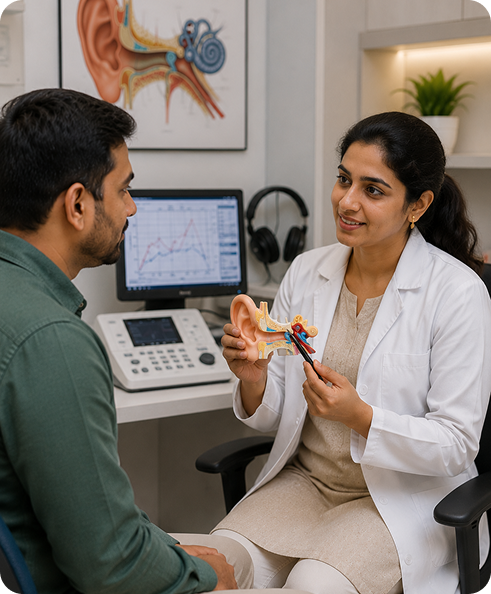
What Is an Adult Hearing Test?
A hearing test for adults, also called an adult hearing evaluation or adult hearing screening, is a clinical assessment that measures how well the auditory system is functioning across a range of sound frequencies. It identifies the type, degree, and configuration of any hearing loss present, whether that loss originates in the outer ear, middle ear, or the inner ear and auditory nerve. The test does not treat hearing loss directly; it establishes a diagnostic baseline from which treatment decisions are made.
The evaluation typically covers multiple components rather than a single test. Pure tone audiometry, a procedure that maps which specific frequencies a patient can no longer hear at normal volumes, forms the core of every assessment. Speech audiometry then measures how clearly the patient can understand spoken words at various volume levels. These two results together produce a picture that a hearing loss percentage alone cannot provide.
At RISE, adult hearing evaluations are conducted using calibrated audiological equipment in a soundproofed environment. Every test is administered and interpreted by qualified audiologists, and findings are explained in plain language before any recommendation is made.
Signs You May Need a Professional Hearing Screening
Most adults with early hearing loss are not aware of it. The changes are gradual and easy to attribute to other causes. A hearing test for adults in Chennai is appropriate if any of the following apply
Difficulty Understanding Conversations in Noisy Environments
Restaurants, family gatherings, and public spaces become genuinely difficult to follow, not merely inconvenient. Background noise that others filter out disrupts the ability to track speech.
Frequently Increasing TV or Phone Volume
When the volume setting that was comfortable a year ago no longer seems adequate, or when others in the same room find your preferred volume too loud, hearing sensitivity has likely declined.
Ringing, Buzzing, or Hissing Sounds (Tinnitus)
Tinnitus, the perception of sound with no external source, is frequently associated with underlying cochlear damage or noise-induced hearing loss and warrants a full evaluation.
Trouble Hearing High-Pitched Voices
High-frequency hearing loss, the most common pattern in adults, often affects the ability to hear women's and children's voices clearly before any difficulty with lower-pitched sounds becomes noticeable.
A Persistent Sense that Others are Mumbling
When speech sounds muffled or unclear rather than simply quiet, it suggests a problem with speech discrimination, not just volume sensitivity.
You do not need a referral from a physician to schedule an adult hearing screening. If any of these signs are present, a formal evaluation is the correct next step.
What to Expect During the Adult Hearing Test
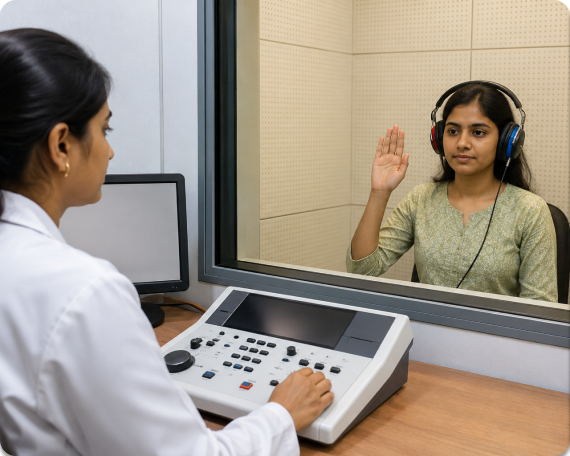
Pure Tone Audiometry to Measure Hearing Levels
Pure tone audiometry is the starting point of every adult hearing evaluation. The patient wears headphones and responds each time a tone is heard, across a range of frequencies from low pitch to high. The audiologist records the softest level at which each frequency is detected, in decibels, the unit used to measure sound intensity.
These results are plotted on an audiogram, a graph showing the patient’s hearing thresholds across the frequency range. The audiogram distinguishes normal hearing from mild, moderate, severe, or profound hearing loss and shows which specific frequencies are affected.
Speech Audiometry to Assess Clarity of Speech Understanding
A pure tone result shows what sounds reach the ear. Speech audiometry goes further and tests whether the brain is correctly processing what it hears. The patient listens to a series of words or sentences at controlled volumes and repeats them back.
The percentage of words understood correctly at a given volume gives the audiologist critical information about speech discrimination ability, which affects hearing aid programming and candidacy decisions.
Tympanometry to Evaluate Middle Ear Health
Tympanometry evaluates the condition of the middle ear by measuring how the eardrum responds to changes in air pressure. It detects problems such as fluid behind the eardrum, a perforated eardrum, or dysfunction of the ossicles, the three small bones that transmit sound from the eardrum to the inner ear. This test is painless and takes under two minutes.
Otoacoustic Emissions (OAE) Test
An otoacoustic emissions test measures faint sounds produced by the cochlea, the hearing organ of the inner ear, in response to a stimulus. When the outer hair cells of the cochlea are functioning normally, they generate these sounds. An absent or reduced OAE response can indicate cochlear damage even before it appears clearly on a pure tone audiogram, making this a useful screening and diagnostic tool.
Tinnitus Evaluation
For patients reporting tinnitus, the evaluation includes an assessment of the pitch and loudness of the perceived sound, as well as how significantly it affects daily function and sleep. This information is used to guide management strategies, which may include sound therapy or hearing aid features specifically designed to provide relief.
Poor Academic Performance or Inattentiveness
Hearing problems and attention difficulties can present in very similar ways. If your child is struggling in school, a hearing assessment helps rule out hearing as a contributing factor before other explanations are explored.
Frequent Ear Infections
Recurring ear infections can temporarily or permanently affect hearing and should always be monitored carefully. If your child has experienced multiple ear infections in a single year, a hearing evaluation is strongly recommended.
How Long Does a Hearing Test Take?
A standard adult hearing evaluation at RISE takes approximately 45 to 60 minutes, depending on the number of tests required. Patients who also need a tinnitus evaluation or a more detailed middle ear assessment should allow up to 90 minutes. For a detailed breakdown, see: How Long Does a Hearing Test Take?
Benefits of an Adult Hearing Assessment

Preserves Brain Health and Reduces Cognitive Decline
Untreated hearing loss is now well-documented as an independent risk factor for accelerated cognitive decline and dementia in older adults. When the brain consistently receives degraded or incomplete auditory signals, it reallocates cognitive resources toward decoding speech, leaving less capacity for memory and executive function. Identifying and treating hearing loss early reduces this cognitive load and supports long-term brain health.
Improves Communication and Reduces Isolation
Adults with unaddressed hearing loss frequently withdraw from group conversations, social events, and family interactions because the effort required is exhausting. Accurate diagnosis makes targeted treatment possible. Treated hearing loss is directly associated with improved communication, more active social participation, and better overall quality of life.
Protects Ear Health by Detecting Problems Early
Several conditions that cause hearing loss, including middle ear infections, abnormal fluid accumulation, and benign growths such as cholesteatoma, are treatable when identified early. A hearing evaluation that includes tympanometry can flag these conditions before they progress to permanent structural damage.
Reduces Mental Fatigue and Exhaustion from Listening
Adults with undetected hearing loss routinely experience disproportionate mental exhaustion after conversations. This occurs because the brain compensates intensively for incomplete auditory information throughout the day. Diagnosing the hearing loss and addressing it directly removes the source of this strain.
Enables Accurate Hearing Aid Selection
No hearing aid can be correctly selected or programmed without a detailed audiogram. The prescription settings for a hearing aid are derived directly from the hearing thresholds recorded during the evaluation. A test is not a precursor to a sale; it is the clinical foundation that determines whether amplification is needed, what degree is appropriate, and which technology is likely to produce the best functional outcome for a given patient.
Hearing Aid Options for Adults at RISE
Behind-the-Ear (BTE) Hearing Aids
BTE hearing aids house the main electronics in a casing that sits behind the ear, with sound delivered to the ear canal through a thin tube or earmould. They are suitable for a broad range of hearing loss degrees, from mild to profound, and are typically easier to handle for patients with limited manual dexterity.
In-the-Ear (ITE) and Invisible-in-Canal (IIC)
ITE models sit entirely within the outer ear, while IIC models are fitted deep within the ear canal and are not visible during normal conversation. Both styles are custom-moulded to the individual ear. IIC devices are appropriate for mild to moderate hearing loss and are chosen primarily by patients for whom cosmetic discretion is a priority.
Receiver-in-Canal (RIC) Hearing Aids
RIC devices keep the main body behind the ear but place the receiver, the component that delivers sound, directly in the ear canal via a thin wire. This separates the microphone from the receiver, which reduces feedback and generally produces a more natural sound quality. RIC models are among the most widely prescribed styles internationally and suit mild to severe hearing loss.
Advanced Hearing Aid Technologies to Look For
Modern hearing aid technology has changed substantially. When reviewing options following your evaluation, the following features are clinically and practically relevant.
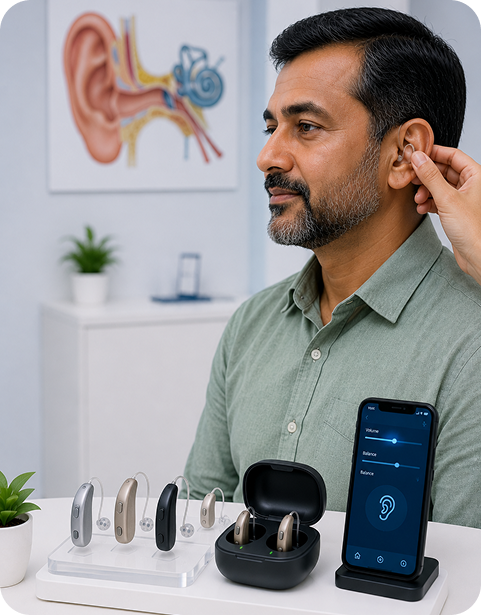
Bluetooth Connectivity
allows hearing aids to stream audio directly from smartphones, televisions, and computers. This eliminates the signal degradation that occurs when sound travels through open air before reaching the hearing aid microphone.
Rechargeable Batteries
eliminate the need to handle small disposable batteries, which is a meaningful practical advantage for older adults or those with reduced fine motor control.
Noise Reduction and Speech Enhancement
use digital processing to identify and suppress background noise while preserving speech signals. This is directly relevant to the single most common complaint of hearing aid users: difficulty in noise.
Directional Microphones
focus amplification on sound coming from in front of the patient, helping in face-to-face conversation and reducing the processing load in noisy environments.
Feedback Cancellation Systems
detect and eliminate the whistling sound that earlier hearing aid generations produced. Current systems manage feedback in real time without affecting the amplification of other sounds.
AI-Driven Sound Classification
enables hearing aids to automatically identify the acoustic environment, including: a quiet room, a noisy restaurant, or an outdoor setting, and adjust processing parameters accordingly.
Hands-Free Calling Support and Smartphone App Control
allow patients to answer calls directly through their hearing aids and adjust volume, programme, and settings from a phone application, without touching the device.
For a detailed breakdown of available styles, brands, and technology tiers, see the Complete Guide to Hearing Aid Types and Technology.
Why Choose RISE for Hearing Tests
Qualified Audiologists and Specialists
Every adult hearing evaluation at RISE is conducted by qualified audiologists with clinical experience across a range of hearing conditions. The evaluation findings are interpreted and explained by the same clinician who conducted the tests, ensuring continuity and accuracy in diagnosis.
Advanced Diagnostic Technology
RISE uses audiological equipment that meets the technical standards required for clinical-grade hearing assessment. The testing environment is acoustically controlled to prevent ambient sound from affecting threshold measurements. These conditions are necessary to produce reliable, repeatable audiogram results.
Personalised Patient Care
There is no standard protocol applied to every patient. The choice of tests, the depth of the evaluation, and the follow-up discussion are shaped by each patient's presenting concerns, medical history, and hearing profile. Patients leave with a clear written summary of their results and a specific set of recommended next steps.
Post-Test Support and Follow-Up
The relationship with RISE does not end at the point of a test result. For patients who proceed with hearing aids, ongoing maintenance, fine-tuning appointments, and long-term audiological support are part of the service. Patients who require referral to an ENT specialist or other medical consultation receive direct guidance on next steps.
Is There Anything Else to Know Before Your Hearing Test?
Avoid exposure to loud noise, such as loud music or heavy machinery, for at least 24 hours before your appointment. Temporary noise-induced threshold shifts can affect test results. If you use hearing aids already, bring them to the appointment. If you have recent medical reports or an earlier audiogram from another clinic, bring those as well. Ear wax that blocks the ear canal should ideally be removed before the evaluation; if you are unsure whether wax is a factor, the audiologist can assess this during the appointment itself.
Frequently Asked Questions (FAQs)
Are hearing tests painful or risky?
Hearing tests are non-invasive and carry no clinical risk. Pure tone audiometry involves listening through headphones and responding to sounds. Tympanometry involves a soft probe placed at the ear canal entrance and a brief change in air pressure. Neither procedure causes pain. OAE testing involves a small earphone tip placed at the entrance of the ear canal and is similarly painless.
How much does an adult hearing test cost in Chennai?
The cost of a hearing evaluation at RISE Hearing Aid Centre depends on the tests included in the assessment. Patients requiring only a basic screening will incur a different fee from those needing a full diagnostic evaluation with tinnitus assessment. Contact RISE directly for current pricing. Many corporate health insurance policies do cover audiological evaluations; it is worth checking your policy before your appointment.
Can a hearing test detect the root cause of my tinnitus?
A hearing evaluation can identify the degree of any associated hearing loss and rule out certain structural causes, such as middle ear problems. However, tinnitus has multiple possible causes, not all of which are detectable through audiometric testing alone. In cases where the evaluation suggests a medical origin, the audiologist will refer the patient to an ENT specialist for further investigation.
What is the difference between age-related hearing loss and noise-induced damage?
Age-related hearing loss, clinically called presbycusis, produces a gradual, symmetrical decline across high frequencies in both ears, progressing slowly over years. Noise-induced hearing loss often produces a characteristic notch at the 4000 Hz frequency on the audiogram and may affect one ear more than the other depending on noise exposure history. Both types can coexist. The audiogram pattern, combined with the patient’s history, helps the audiologist distinguish between them and guide management.
If my hearing test shows loss in both ears, do I really need two hearing aids?
In most cases, yes. The auditory system is designed to process sound binaurally, meaning the brain uses input from both ears to locate sounds, reduce listening effort in noise, and maintain clarity in conversation. Fitting only one ear when both show measurable loss often produces a poorer functional outcome and can accelerate auditory deprivation in the unfitted ear over time. Your audiologist will discuss this with you directly based on your specific audiogram.
Can ear wax affect my hearing test results?
Yes. Significant wax accumulation can block the ear canal partially or completely, attenuating sound before it reaches the eardrum. This produces artificially elevated hearing thresholds on the audiogram, suggesting greater hearing loss than exists. If wax is present, it should be removed by a clinician before testing. Your audiologist will check for wax obstruction at the start of the evaluation.
How soon can I get hearing aids after my evaluation?
or standard hearing aid models, fitting can often be scheduled within a few days of the evaluation. Custom-moulded devices, including ITE and IIC styles, require an ear impression and a manufacturing period of approximately one to two weeks. Your audiologist will confirm the expected timeline based on the device recommended.


Take the First Step — Book Your Consultation
Book an assessment with RISE certified specialists and get a clear, personalised plan for your or your child’s hearing, communication, or developmental needs.